
Views: 0 Author: Site Editor Publish Time: 2026-11-04 Origin: Site


Managing fine powders during high-volume bulk bag filling creates a persistent operational pain point. Operators often watch valuable product disappear into thin air. Airborne dust quickly turns a standard process into a messy hazard. As product enters the bag, displaced air must exit. If the spout connection or bag design is inadequate, airborne particulates escape into the facility. This failure exposes your business to several severe consequences. Combustible dust hazards trigger strict NFPA and OSHA compliance violations. You also suffer direct product yield loss. Facilities face higher cross-contamination risks and increased sanitation labor. We will break down exactly why these leaks happen. You will learn how to diagnose root causes at the spout connection. Finally, we will evaluate both equipment-side upgrades and bag-side solutions to completely eliminate airborne waste.
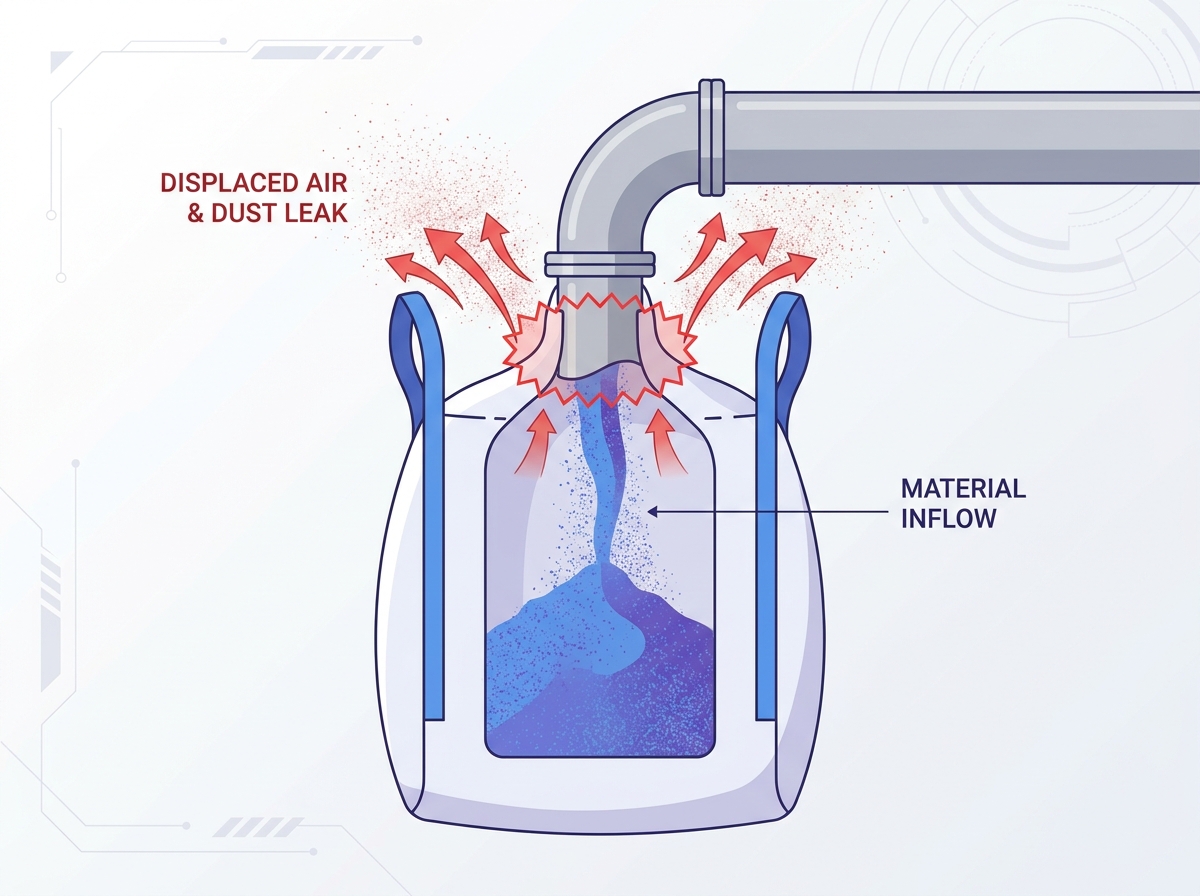
Dust leakage at the spout is primarily driven by displaced air pressure and improper seal integrity between the fill pipe and the FIBC spout.
Effective bulk bag filling dust control requires a matched system: the right filling hardware (like inflatable collars) paired with appropriately sized bag spouts.
For ultra-fine powders, standard bags are insufficient; sift proof FIBC bags with specialized seam construction are required to prevent particle migration under pressure.
Upgrading spout designs or fill-head equipment yields measurable ROI through reduced material loss and lower facility maintenance costs.
Bulk filling relies on basic physics. Dense material drops into the FIBC. It immediately displaces an equal volume of air inside the container. This displaced air searches for an exit. Without proper venting mechanisms, the air forces its way out. It naturally follows the path of least resistance. Usually, this path is the spout connection point. The surging air carries microscopic particles outward. High-velocity material drops create higher air pressure spikes. These pressure spikes easily compromise weak fabric seals. You must account for this air volume to stop fibc filling spout dust leakage. Active venting prevents pressure buildup entirely.
Mechanical failure frequently happens at the connection point. The bag's inlet spout diameter often exceeds the filling nozzle size. This size discrepancy causes major operational headaches. Operators attempt to cinch the excess fabric around the pipe. Folds and creases naturally form in the stiff polypropylene. These cinching gaps create perfect escape tunnels. Dust escapes easily through these small tunnels. Specifying exact spout dimensions eliminates this problem. You need the spout to fit snugly over the equipment. A precise fit minimizes excess fabric folds.
Many facilities still rely on outdated closure methods. Standard drawstrings fail to create a true hermetic seal. Zip ties also leave microscopic gaps around rigid metal pipes. Manual clamping depends heavily on operator skill. Operators apply uneven pressure when tying off bags manually. Rigid pipes do not compress. Fabric must conform perfectly to the pipe exterior. Manual ties cannot force fabric into a perfectly airtight shape. These mechanical limitations guarantee slow, steady particulate leakage. You must move beyond simple drawstrings for fine materials.
Certain materials change behavior during the filling process. Flour, carbon black, and fine chemicals become highly aerated. They stop acting like solid bulk solids. Instead, they behave exactly like fluids. Fluidized powders actively seek microscopic gaps. They migrate through standard woven fabric intersections. They also find weak spots at the connection point. This behavior makes fluid powders notoriously difficult to contain.
Oversized spout diameters creating excessive fabric folds.
Worn or fraying manual drawstrings lacking tension.
Rigid fill pipes lacking compressible sealing collars.
Absence of displaced air venting systems.
Use of standard woven polypropylene for ultra-fine materials.
Airborne particulate buildup introduces severe facility risks. Dust poses direct respiratory hazards for line operators. Chronic exposure leads to long-term employee health issues. A larger threat looms in the form of secondary explosions. Combustible dust settles on rafters and equipment. A small initial spark ignites suspended dust. This triggers a catastrophic secondary explosion. OSHA and NFPA enforce strict compliance standards regarding dust accumulation. Failing an audit brings heavy fines and potential facility closures. Protecting your workforce requires eliminating airborne particulates completely.
Losing product during filling impacts your bottom line. A small puff of dust seems insignificant initially. However, calculate this loss over an entire annual production run. Losing a fraction of a percentage of yield per bag adds up. It equals thousands of pounds of wasted inventory annually. This wasted material represents pure lost revenue. You paid to manufacture it, but cannot sell it. Capturing this lost yield directly improves profit margins. The financial impact becomes obvious once you track it.
Dust does not just vanish into the air. It settles heavily on nearby machinery. Fine powder infiltrates sensitive electronic sensors. It works its way into mechanical bearings. This abrasive powder accelerates mechanical wear and tear. Preventative maintenance frequency must increase to compensate. Your sanitation team spends hours sweeping and vacuuming. This extra labor pulls focus away from core operations. A clean filling station extends overall equipment lifespan dramatically.
Safety: Combustible dust accumulation and respiratory dangers.
Financial: Cumulative annual yield loss per bag filled.
Maintenance: Accelerated wear on bearings, sensors, and moving parts.
Labor: Increased sanitation hours required per shift.
Proper hardware upgrades solve the mechanical sealing problem. Inflatable collars replace rigid, static fill pipes. The operator slides the bag spout over the deflated collar. The system then inflates a heavy-duty rubber bladder. This bladder expands outward against the inside of the spout. It creates a complete 360-degree, dust-tight seal. The pneumatic pressure flattens any minor fabric creases. This ensures zero particulate escape during the fill cycle. Bladder seals represent the gold standard for sealing integrity.
Handling displaced air requires specialized engineering. Twin-tube nozzles feature a smart concentric design. The inner tube handles the direct product flow downward. The outer tube connects to a facility dust collection system. It actively vacuums the displaced air upward. This creates a balanced, negative pressure environment. The vacuum pulls air out before it hits the spout connection. This dual-action hardware provides superior bulk bag filling dust control for difficult materials.
Sudden air displacement surges stress the bag seams. You can prevent this by pre-inflating the bag. The system uses ambient air to inflate the FIBC completely. This occurs right before the heavy material drop. Pre-inflation shapes the bag perfectly. It pulls the corners tight and stretches the fabric. The material then falls into an already expanded space. This dramatically reduces the violent expulsion of internal air.
Equipment upgrades require careful planning. New filling heads involve significant capital expenditure. You must also account for operator retraining time. Audit your existing infrastructure carefully before purchasing. Ensure your current dust collectors can handle new negative pressure demands. Evaluate the ceiling height to accommodate twin-tube nozzles. Rushing into hardware upgrades without an audit causes integration failures.
Equipment-Side Fill Head Comparison
Technology Type | Primary Function | Best Use Case | Implementation Difficulty |
|---|---|---|---|
Static Rigid Pipe | Basic material gravity drop | Coarse granules, aggregates | Low |
Inflatable Bladder | 360-degree pneumatic fabric seal | Standard powders, minor aeration | Medium |
Twin-Tube Nozzle | Simultaneous fill and active vacuum | Fluidized powders, hazardous dust | High |
Standard bags fail when holding ultra-fine particles. Ordinary woven polypropylene breathes by design. The fabric tapes intersect, leaving microscopic gaps. When internal pressure rises, micron-sized dust passes right through. It escapes through the sidewalls and the structural seams. You must transition to specialized bag designs. Sift-proofing blocks these microscopic escape routes. It requires adding physical barriers to the bag's construction. This completely stops particle migration under pressure.
Seams represent the weakest structural point for containment. Needles punch holes through the fabric during manufacturing. Fine powder flows easily out of these tiny stitch holes. Manufacturers solve this by adding specialized filler cords. Single dust seams use one cord to block the holes. Double seams sandwich the fabric between two protective layers. Triple dust seams utilize thick felt strips. The felt compresses under pressure, sealing the stitch line entirely. You must specify these seams for true containment.
You can engineer the spout for better sealing. First, specify exact spout dimensions matching your fill pipe. Stop using generic, oversized spouts. Second, request extended spout lengths. A longer spout provides better clamping surface area. It gives the inflatable bladder more fabric to grip. Third, incorporate specialized B-lock closures or petal designs. These mechanisms allow tighter, more secure cinching. They eliminate the bulky folds caused by standard ties.
Fabric permeability dictates your overall containment success. Uncoated breathable bags work fine for large beans or gravel. They fail miserably for carbon black or flour. You must upgrade to sift proof fibc bags made from coated fabric. Manufacturers laminate the inside with a thin polypropylene film. This completely seals the sidewall porosity. For extreme hazard materials, insert an internal polyethylene liner. Liners offer absolute zero permeability from the spout base down.
Seam Construction Dust Resistance Chart
Seam Type | Construction Feature | Dust Resistance Level |
|---|---|---|
Standard Stitch | Basic needle and thread sewing | Low (High Leakage) |
Single Filler Cord | One cord blocking needle holes | Moderate |
Double Filler Cord | Two cords sandwiching the stitch line | High |
Felt Block Seam | Thick felt strip compressing the seam | Maximum (Sift Proof) |
You must start by analyzing the product itself. The material dictates your required solution. Measure the exact bulk density of your powder. Determine the precise moisture content. Find the average micron size of the particles. Dry, ultra-fine materials require maximum sift-proofing. Heavier, moist materials forgive minor spout gaps. Watch how the powder behaves during movement. If it acts like water, you need an airtight seal. This audit prevents over-engineering or under-engineering your solution.
Decision-makers must balance short-term costs against long-term gains. You face a clear choice. Do you upgrade the consumables or the machinery? Paying a $2 premium per bag for complex designs adds up. Over 10,000 bags, you spend $20,000 extra annually. Alternatively, you could invest $15,000 once in a new automated fill head. The equipment upgrade solves the problem permanently. You can then buy cheaper, standard bags. Map these costs out on a simple decision matrix. Find the breakeven point for your specific production volume.
Never commit to a massive procurement cycle blindly. Always initiate a controlled pilot test first. Order 50 to 100 modified bags for a trial run. Run them through your standard filling process. Emphasize measuring the ambient dust levels during the trial. Use air quality monitors near the filling station. Weigh the bags to check for precise yield capture. Inspect the seams and spout connections visually. Validate the solution based on hard data, not assumptions.
Eliminating dust at the filling spout requires treating the bag and the filling machinery as an integrated system. You cannot fix the issue by treating them as isolated components. Relying on manual tie-offs for fine powders remains an outdated and highly inefficient practice. Upgrading your hardware to use active venting and pneumatic seals stops airborne waste immediately. Pairing that hardware with specialized coated fabrics ensures long-term operational cleanliness. Facility managers should take immediate action. We encourage you to request an operational audit from an FIBC specialist. They will map your material flow and pinpoint the exact point of failure in your current filling setup.
A: There should be a zero-gap seal between the pipe and the spout. Any visible gap allows microscopic particles to escape under pressure. You achieve this zero-gap seal by using inflatable bladders or specifying exact-match spout diameters.
A: Standard bags have severe limitations. You can easily insert polyethylene liners into existing bags to improve sidewall containment. However, structural spout modifications or adding specialized dust seams require manufacturing completely new bag specifications.
A: It integrates through concentric venting technology. An outer tube connects directly to the dust collector. This creates a negative pressure balance. It vacuums out the displaced air continuously without vacuuming out the heavy product itself.