
Views: 0 Author: Site Editor Publish Time: 2026-10-20 Origin: Site


Transitioning from traditional manual stacking to bulk material handling is a major operational shift. It completely transforms how commercial firewood suppliers and high-volume consumers manage their daily workflows. Standard bulk storage options often trap moisture inside the load. This severely slows the drying process and causes rapid wood rot. Specialized breathable containers offer a much better solution for modern operations. They combine the logistics of a palletized system while delivering the crucial airflow required for proper seasoning.
However, these containers are not a universal fix for every business. Their ultimate suitability depends heavily on your available lifting equipment, local climate, and existing storage infrastructure. This guide examines the structural, financial, and environmental realities of processing, storing, and transporting wood in bulk. You will learn exactly how airflow mechanics work in practice. We will also cover safety factor ratings and highlight critical implementation risks to avoid.
Ventilated bags significantly reduce labor costs by eliminating double-handling, provided the operation utilizes mechanized lifting equipment (forklifts or skid steers).
They are highly suitable for outdoor, pallet-elevated storage of green or semi-seasoned wood, provided the bags have high UV-stabilization ratings and top covers.
The actual return on investment depends on the bag's Safety Factor (SF) rating and handling practices; expect a realistic lifespan of 1 to 3 seasons, not indefinite use.
Bags packed tightly together without adequate spacing will stall the seasoning process and can lead to internal mold, even with ventilated mesh.
Evaluating these bags requires looking beyond the initial unit price. You must analyze the total cost of handling material throughout the year. The traditional cordwood model relies heavily on manual labor. Workers pick up logs, stack them, unstack them, and toss them into delivery trucks. This process wastes time and erodes profit margins. Shifting to a bulk model changes the economic fundamentals of your operation.
Labor Reduction: The primary commercial driver for adoption is minimizing touchpoints. Wood goes directly from the mechanical splitter into the bag. It remains safely inside for drying, storage, and eventual delivery. Operators skip the manual stacking phase entirely. This single operational change saves countless man-hours every week. You pay your staff to split wood, not to move the same log three times.
Mechanization Requirements: Bags fully loaded with hardwood can weigh between 1,000 and 1,500 lbs. Implementation is only viable if the operation has access to capable lifting equipment. You must safely lift and maneuver this massive weight via the fabric corner loops. Skid steers, compact track loaders, and standard warehouse forklifts work perfectly. You cannot manually muscle these containers around the yard.
Standardization of Volume: For B2C and B2B sales, specific bag dimensions allow suppliers to sell standardized fractional cords. A very common size is 36" x 36" x 36". This ensures highly transparent transactions for the buyer. It also guarantees predictable transport loads for the seller. Delivery trucks can maximize their flatbed footprint easily. You avoid the guesswork associated with loose-tossed loads.
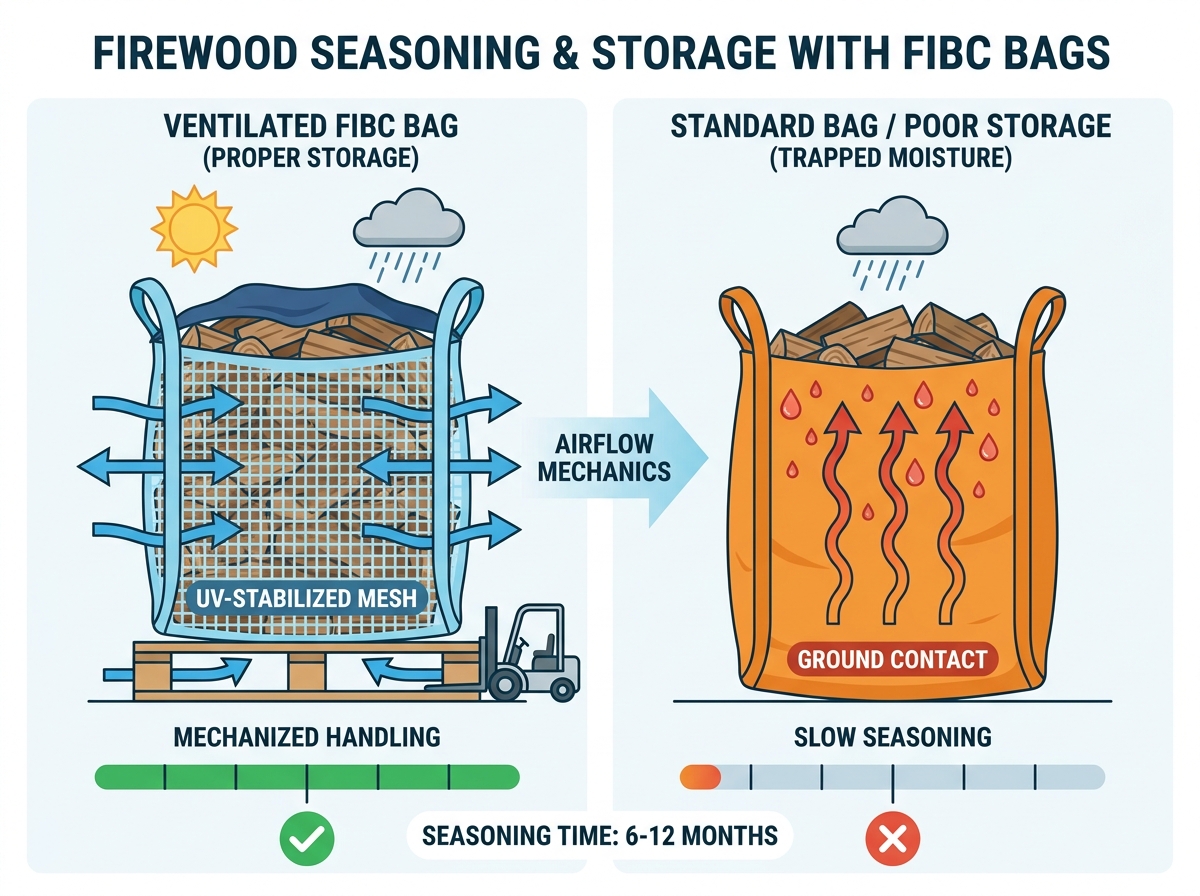
The defining feature of these bags is their incredible ability to facilitate airflow. However, mesh walls alone do not guarantee properly seasoned wood. You must actively manage the environmental conditions surrounding your storage yard.
Airflow Mechanics: Manufacturers construct these products using distinct fabric styles. They typically utilize either striped breathable fabric or heavy-duty mosquito-style netting on all four sides. The striped style alternates solid woven polypropylene alongside vented vertical strips. The netting style provides superior cross-ventilation for high-moisture green wood. High-quality ventilated fibc bags act like a rigid net. They allow prevailing winds to push right through the pile. This continuous breeze pulls moisture away from the interior logs.
The Moisture Trap Risk: Even highly breathable containers require ambient wind to function. Imagine placing damp logs inside a closed, stagnant barn. If you pack the bags shoulder-to-shoulder without airflow channels, problems arise immediately. The microclimate inside the bag will remain extremely humid. This severely slows the seasoning process. Fungi and mold thrive under these stagnant conditions. We strongly recommend leaving at least six to twelve inches of gap space between rows. Operators need this space to maneuver machinery anyway.
Ground and Precipitation Factors: Suitable storage requires elevating the bags on sturdy wooden pallets. This critical step allows bottom airflow. It also prevents the lower logs from absorbing ground moisture. Wood sitting directly on wet soil will wick water upward continuously. This rots both the lower logs and the bag fabric prematurely. Proper elevation acts as a necessary barrier against pooling rainwater and spring snowmelt.
To justify the upfront financial investment, buyers must evaluate the engineering specifications carefully. You need to understand their true lifecycle in a harsh commercial environment. Avoid treating these heavy-duty items like single-use consumer packaging. Proper selection guarantees a higher return on investment.
UV Resistance Ratings: Standard industrial polypropylene degrades rapidly under direct sunlight. Ultraviolet rays break down polymer chains over a few months. Suitable firewood bags must specify high UV stabilization during the manufacturing process. They are typically rated to retain a certain percentage of tensile strength after 1,200+ hours of UV exposure. Without this chemical protection, the fabric becomes brittle. It will eventually shatter during routine forklift lifting.
Safe Working Load (SWL) & Safety Factor (SF): Look for bags featuring an SWL of at least 1,000 kg (2,200 lbs). You must also verify the exact safety factor rating. A standard SF of 5:1 designates single-trip use only. An SF of 6:1 indicates true multi-trip capabilities. For reusable firewood operations, a 6:1 rating is structurally necessary. It helps the bag withstand repeated hoisting, sudden drops, and long-term UV fatigue.
Operational Wear and Tear: Sharp log edges and aggressive forklift handling cause inevitable snags. Operators occasionally scrape the fabric against rough barn walls or truck beds. Factoring in accidental tears and general UV degradation, a realistic commercial lifespan is 1 to 3 years. We strongly advise tracking usage cycles to predict replacement schedules accurately. High-quality ventilated bulk bags for firewood handle abuse better, but they remain a consumable supply.
Safety Factor (SF) Specifications for Bulk Containers
Safety Factor Rating | Usage Classification | Operational Suitability for Firewood |
|---|---|---|
5:1 SF | Single-Trip Use | Best for retail delivery where the bag stays with the end customer. Do not reuse for heavy yard work. |
6:1 SF | Multi-Trip Use | Required for commercial yard storage. Designed to handle repeated lifting, filling, and emptying cycles. |
8:1 SF | Heavy-Duty Multi-Trip | Rare in firewood, used mainly for hazardous materials. Extreme durability but highly cost-prohibitive. |
Adopting bulk systems introduces specific operational risks. You must manage these carefully to avoid product loss or workplace injuries. Understanding these physical limits separates profitable operations from dangerous ones. Do not assume these bags function exactly like rigid steel cages.
Stacking Hazards: Some rigid or internally baffled FIBCs can be safely stacked. Standard firewood bags, however, tend to bulge outward naturally. Stacking them two-high requires extreme caution and careful planning. You absolutely need perfectly level ground in your yard. You also need robust top loops and an experienced forklift operator. Otherwise, the stack poses a serious tipping hazard. Falling logs weigh enough to cause severe injury or equipment damage.
Top Exposure: Mesh sides let air in freely. Unfortunately, wide-open tops let rain and snow in just as easily. Operations must invest in bags offering integrated tie-down skirt covers. Alternatively, you can use independent top-cover tarps to shield the wood. Storing bags under an open-sided lean-to works perfectly. Exposed wood acts like a sponge during heavy downpours. This completely negates the drying benefits of the mesh sides.
Debris Accumulation: Bark, dirt, and wood chips will accumulate at the solid bottom over time. This layer of organic matter traps moisture against the lowest logs. You must periodically clean the containers between filling cycles.
Follow this numbered list for proper maintenance between seasons:
Empty all seasoned wood carefully before the deep winter freeze sets in.
Invert the empty container entirely to dislodge large pieces of loose bark.
Shake the fabric vigorously to remove trapped soil, sawdust, and nesting insects.
Inspect the four lifting loops closely for any signs of thread fraying or tearing.
Fold the clean containers neatly and store them in a dry, dark shed to prevent off-season UV damage.
If your operation meets the mechanization and spacing requirements, you can confidently move forward. Use these specific criteria to shortlist your commercial suppliers. Selecting the correct structural design makes daily operations significantly smoother. It also reduces frustration for your heavy machinery operators.
Loop Design: Cross-corner loops are generally superior to standard four-corner loops for firewood operations. They are sewn to stand upright and open independently. This brilliant feature allows a single forklift operator to enter the loops smoothly. You do not need a second person manually holding them open on the ground. This small design tweak saves countless hours over a busy season. It also keeps ground workers safely away from moving machinery.
Bottom Construction: Choose a flat, solid bottom for maximum strength and load distribution. Spout bottoms are very often used in agriculture for releasing grain or fertilizer. They are generally too weak for heavy, jagged hardwood logs. The discharge spout creates an unnecessary structural weak point. High-quality heavy-duty bags utilize a reinforced flat base. This base easily handles the blunt force of split logs dropping from a conveyor.
Ventilation Configuration: Decide between two-sided venting or four-sided mesh. Two-sided venting offers better structural integrity. However, it requires careful yard alignment with prevailing winds. Four-sided mesh delivers maximum drying speed and airflow. It is slightly more susceptible to bulging and minor snagging. We suggest evaluating your local wind patterns before ordering firewood bulk bags. If you live in a highly humid environment, maximize the mesh surface area.
Ventilated FIBC bags are a highly suitable and economically sound choice for firewood storage. They excel when integrated into a mechanized workflow prioritizing handling efficiency. They perform best in outdoor or open-shelter environments. Here, pallet elevation and adequate yard spacing allow natural wind to dry the wood rapidly.
However, they are not suitable for manual, hand-loaded operations. They will never compensate for poor storage practices like ground-contact or tightly packed indoor stacking. Sourcing bags featuring high UV resistance and appropriate Safe Working Load ratings remains absolutely critical. This ensures the bags survive multiple seasons.
Here are your action-oriented next steps for implementation:
Assess your current forklift or skid steer lifting capacity before purchasing any bulk containers.
Prepare a leveled, well-drained staging yard utilizing sturdy wooden pallets for base elevation.
Order a small test batch of containers to evaluate mesh durability against your specific wood species.
Train your machinery operators on safe maneuvering techniques to prevent loop damage.
A: It is generally not recommended unless the bags are specifically engineered with internal baffles to prevent bulging. Standard bags will shift as the wood dries and shrinks. This shifting makes multi-tier stacks highly unstable and dangerous for workers nearby.
A: With four-sided mesh, elevated pallet placement, and adequate exposure to sun and wind, green wood will dry at roughly the same rate as a traditional loose stack. This typically takes 6 to 12 months, depending heavily on the wood species and local climate conditions.
A: Yes, snagging is the most common cause of premature bag failure. Dropping split logs from a conveyor directly into the bag reduces handling damage compared to aggressively tossing them by hand. Buyers should expect minor mesh abrasions over time due to jagged bark.
A: Yes, provided they are manufactured with heavy UV stabilization and the wood is protected from direct precipitation. You must use a top cover or independent tarp. Uncovered bags will fill with snow, trapping destructive moisture against the wood during the spring thaw.