
Views: 0 Author: Site Editor Publish Time: 2026-10-25 Origin: Site


Frayed lifting loops are not just minor wear-and-tear issues. They pose an immediate safety hazard in your facility. They also indicate a severe mismatch between your operational equipment and FIBC specifications. Warehouse managers frequently blame operator error when lifting straps break. However, chronic fraying usually stems from structural incompatibilities. Your bag design must seamlessly match your specific bulk bag forklift handling procedures.
Ignoring this mechanical misalignment puts your floor personnel at serious risk. Resolving the problem requires a completely objective audit of mechanical stress factors. You must carefully evaluate loop construction and verify supplier material standards. In this guide, we will explore how dynamic loading impacts loop integrity. You will learn how to identify structural flaws before they cause a failure. Finally, we provide a concrete framework to secure the correct bag architecture for your operation.
FIBC lifting loop damage is most frequently caused by improper forklift tine spacing, sharp tine edges, or sudden dynamic loading.
Selecting the correct loop architecture—such as upgrading to FIBC cross corner loops for specific forklift configurations—drastically reduces shear stress.
Preventing failure requires evaluating suppliers on Safe Working Load (SWL) compliance, UV resistance, and reinforced loop options, rather than competing solely on unit price.
Understanding the root causes of fibc lifting loop damage helps you mitigate severe compliance risks. Loop failure is never an isolated event. It triggers a cascade of operational and financial consequences across your facility.
A dropped bulk bag is a worst-case scenario. When a loop frays and snaps during transit, a thousand kilograms of material can fall instantly. This endangers anyone walking near the loading zone. Workplace injuries from falling loads invite strict regulatory scrutiny. Agencies like OSHA closely monitor material handling accidents. A single incident can trigger comprehensive facility audits, mandatory safety retraining, and temporary shutdowns. Maintaining intact lifting loops is your primary defense against these safety violations.
Frayed loops carry massive hidden costs in the form of downtime. When an operator notices a damaged loop, they must stop production immediately. They have to safely ground the bag and transfer its contents to a secure container. This transfer process halts workflows and wastes valuable labor hours. Furthermore, if the loop fails entirely before the operator notices, the resulting spill ruins high-value bulk materials. Cleanup costs multiply exponentially if you handle hazardous chemicals or fine powders.
Consistent fraying signals a disconnect within your organization. Purchasing teams often buy standard bags based on unit price. Meanwhile, the operational reality requires heavy-duty or specialized handling solutions. Standard corner loops simply cannot survive in high-friction environments. Recognizing this misalignment allows you to bridge the gap between procurement strategies and warehouse realities. You need bags engineered specifically for your equipment.
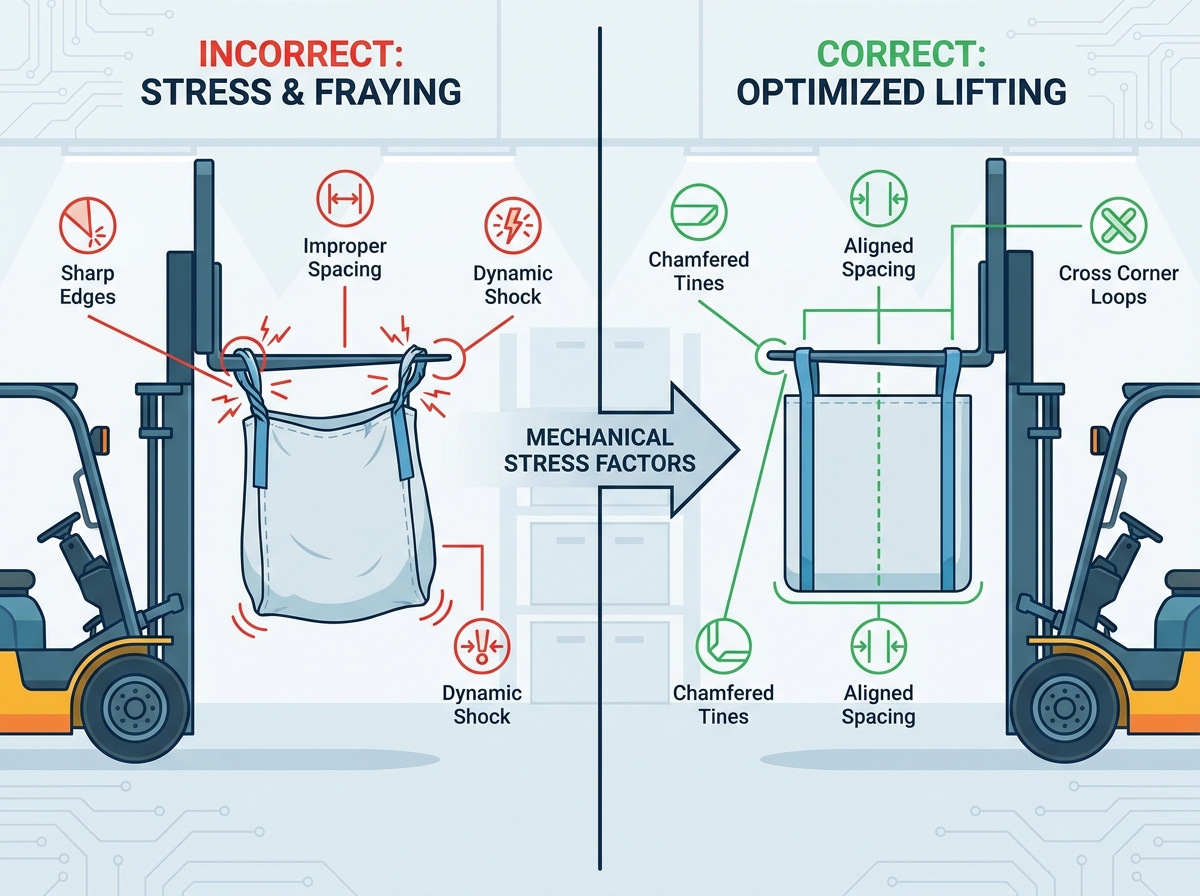
Industrial environments punish flexible intermediate bulk containers. You must analyze the exact mechanical forces interacting with the fabric. Most fraying originates from how the forklift engages the bag.
Forklift hardware heavily influences bag longevity. Operators frequently overlook the physical condition of the forklift tines.
Tine Condition: Unchamfered or sharp-edged forklift tines act like knives. When they lift a heavy bag, these sharp edges press directly into the woven polypropylene fibers. Over time, the metal cuts through the individual yarns, leading to catastrophic fraying. Tines must have rounded, smooth edges.
Improper Tine Spacing: Shear force destroys loops quickly. If tines are spaced too widely, the loops stretch outward at a severe angle. If they are too narrow, the loops bunch inward. Both scenarios force the fabric to bear weight unevenly. The stress concentrates on a few threads instead of spreading across the entire loop width.
Bags are rated for static weight. Dynamic loading, however, multiplies the forces applied to the lifting loops. Shock loading happens during rapid acceleration, sudden braking, or jerking the forklift mast. If an operator drops a 1,000 kg bag even a few centimeters and catches it abruptly, the dynamic force can exceed 3,000 kg. This sudden spike exceeds the bag’s safety factor. The polypropylene yarns stretch beyond their elastic limit and begin to fray instantly.
Friction is the quiet killer of polypropylene fabric. Operators sometimes drag bags across the concrete floor instead of lifting them clear. Worse, they adjust the bag's position by sliding the loops horizontally along the rough steel tines. This abrasive action melts and shreds the plastic fibers. Operators must always lift the bag fully before repositioning it. Sliding creates micro-tears that rapidly evolve into major structural failures.
Entering the loops at an angle, which twists the fabric.
Failing to sand down rust or burrs on the lifting tines.
Driving too fast over uneven warehouse floors, causing the bag to bounce.
Matching the bag design to your lifting machinery prevents most fraying issues. The architecture of the loop determines how it distributes heavy loads.
Standard corner loops are highly common. They are sewn directly onto the side seams of U-panel or tubular bags. They lay flat against the bag when empty. This design requires precise forklift alignment during entry. If an operator enters at a slight angle, the loop twists around the tine. This twisting concentrates the entire load weight onto a tiny fraction of the loop's fabric. Consequently, standard loops accelerate fraying in fast-paced environments where precise alignment is difficult.
Upgrading your design can eliminate chronic handling problems. FIBC cross corner loops offer distinct mechanical advantages. Manufacturers sew these loops into the seams of circular bags. As a result, they bridge the corner and stand perfectly upright on their own. They remain fully open even when the bag is empty.
For high-volume operations, cross corner loops drastically reduce operator handling time. The driver does not need a second person to hold the loops open. More importantly, the upright design provides easier, perfectly aligned access. This prevents twisting, reduces friction against the tines, and ensures even load distribution. You mitigate the risk of snagging and uneven lifting stress.
Sometimes, standard forklift tines are not the primary lifting method. If you use overhead cranes or hoists, you need specialized configurations. Stevedore straps connect the primary loops together, creating a single lifting point. This is ideal for single-hook crane systems. Choosing the wrong loop style for a crane results in immediate uneven tension and fabric tearing.
Feature | Standard Corner Loops | Cross Corner Loops | Stevedore Straps |
|---|---|---|---|
Attachment Style | Sewn flat along the side seams. | Bridged across the corners, sewn into circular seams. | Auxiliary straps connecting the main lifting loops. |
Stance When Empty | Lays flat, requires manual opening. | Stands upright and remains open. | Varies depending on primary loop stance. |
Ideal Machinery | Precision forklift operations. | High-speed forklift operations. | Overhead cranes and single-hook hoists. |
Fraying Risk Level | High (if twisted during entry). | Low (easy alignment prevents twisting). | Low (when used with correct hooks). |
Even the best handling practices cannot save a poorly constructed bag. You must scrutinize the raw materials and manufacturing processes used to build your FIBCs.
The attachment point where the loop meets the bag body is highly vulnerable. Standard bags use basic stitching here. Reinforced lifting loops add extra layers of woven fabric at these critical junctions. They distribute the lifting force over a much larger surface area. Upgrading to reinforced designs is financially viable when you handle ultra-dense materials like steel shot or wet sand. They prevent the loop from tearing away from the bag body under maximum tension.
The thickness of the polypropylene determines its resistance to friction. Fabric weight is measured in ounces per square yard or grams per square meter. Lower-denier, thinner polypropylene is highly susceptible to micro-tears. When tines rub against thin fabric, it shreds quickly. You should specify a higher fabric weight for your loops if they encounter rough handling conditions. Stronger tensile strength prevents the yarns from snapping during minor shock loads.
Sunlight destroys unprotected plastic. Prolonged exposure to ultraviolet rays breaks down polypropylene polymers rapidly. When this happens, the loops become brittle and lose their flexibility. They will fray and snap easily, even under perfectly correct handling conditions. This degradation can occur in just a few weeks of outdoor storage. You must ensure your manufacturer adds high-quality UV inhibitors during the plastic extrusion process. Even with inhibitors, you should always store bags indoors.
Poor quality control leads to premature loop failure. When auditing your bags, inspect the sewing closely.
Subpar Stitching: Look for thin sewing threads that easily break under tension.
Skipped Stitches: Gaps in the seam line create localized stress points where fraying begins.
Insufficient Attachment Length: The loop must run deep down the side of the bag. Short attachment seams pull out easily when lifted.
Sourcing reliable bags requires a structured approach. You cannot rely on visual inspections alone. You must demand technical compliance from your packaging partners.
Before contacting suppliers, you need accurate data from your own warehouse floor. Create a quick checklist for your procurement buyers.
Measure the exact width and length of your forklift tines.
Observe your operators' average lifting speeds to identify shock loading risks.
Check your storage areas for potential UV exposure from windows or open dock doors.
Document the exact weight and density of the bulk materials you package.
Reputable manufacturers test their products rigorously. You must verify the Safe Working Load (SWL) for every bag you purchase. However, SWL alone is not enough. You must demand independent testing certificates proving the industry standard Safety Factor. Single-trip bags must meet a 5:1 Safety Factor. Multi-trip bags must meet a stricter 6:1 Safety Factor. This means a bag rated for 1,000 kg must survive a 5,000 kg test load without the loops breaking. Never purchase from suppliers who cannot provide these certificates.
Never commit to an annual contract based on a paper specification. You should always request physical sample bags first. Order samples featuring different loop configurations. Test standard loops against cross corner variations. Run physical stress tests in your actual warehouse environment. Have your operators load them, lift them repeatedly, and transport them across the facility. Evaluate the loops for any signs of early fraying. This pilot testing phase guarantees that your chosen design perfectly matches your handling equipment.
Partner with suppliers who understand material handling equipment. They should ask you about your forklifts before recommending a bag. They should also offer customization options for loop height and width. This ensures the loops fit your specific tines without stretching or bunching.
Preventing lifting loop fraying is a crucial dual responsibility. You must enforce strict forklift handling protocols on the warehouse floor. Simultaneously, you must procure the correct bag architecture for your specific environment. When you eliminate sharp tines and stop shock loading, bags last significantly longer. Upgrading your designs directly reduces shear stress and prevents catastrophic accidents.
Your next step is to perform a comprehensive audit of your current operations. Inspect your damaged bags today and identify exactly where the fraying occurs. Measure your forklift tines and smooth out any sharp edges immediately. Finally, consult with a technical FIBC specialist to spec out a more resilient, customized loop design. Protecting your operators and your product demands nothing less.
A: No. Any visible fraying compromises the structural integrity of the entire bag. It instantly violates the mandated 5:1 or 6:1 Safety Factor. Lifting a damaged bag risks a catastrophic load drop. You should safely ground the bag immediately and transfer the material to a new, undamaged container.
A: Generally, yes, for standard high-volume forklift operations. They stand upright on their own, offering easier and more aligned access for operators. This alignment reduces twisting and dangerous friction against the tines. However, they must be matched correctly to the bag shape, as they are specifically designed for circular bags.
A: Forklift tines should have rounded, chamfered edges rather than sharp 90-degree angles. They must be completely free of rust, sharp burrs, or jagged metal. Additionally, operators must space the tines appropriately so the lifting loops hang vertically, without stretching outward or bunching inward during the lift.