
Views: 0 Author: Site Editor Publish Time: 2026-10-19 Origin: Site


Handling carbon black presents severe operational realities for manufacturing plants. Its ultrafine particle size and high dispersion rate make it one of the most difficult industrial materials to handle safely. These physical traits cause massive industrial headaches worldwide. Uncontrolled dust loss is definitely not just a simple housekeeping issue. Constant seepage represents measurable yield reduction over time. Airborne particles also create severe cross-contamination risks and introduce potential combustible dust hazards into your facility.
Upgrading to purpose-engineered fibc bags for carbon black effectively solves these containment problems, rather than relying on standard bulk packaging. Standard solutions simply cannot contain the material. Our objective is to provide a complete technical framework. You will learn how to evaluate, specify, and procure bulk bags correctly. This ensures you physically contain carbon black during all transit, storage, and discharge stages.
Standard bulk bags fail with carbon black; specifying a true sift proof fibc requires specific seam sealing and coated fabrics.
Form-fit polyethylene liners provide the highest barrier against ultrafine particle migration but require specific attachment methods to prevent discharge blockages.
Safe handling of a carbon black bulk bag requires strict adherence to static control standards (Type C or Type D bags), as the material is highly conductive and combustible.
Supplier evaluation should hinge on custom engineering capabilities, vibration testing protocols, and cleanroom manufacturing standards.
Seemingly minor seepage during transit or handling aggregates into significant volume loss over an annual production cycle. A few grams lost per bag seems negligible initially. You must multiply this minor seepage across thousands of bulk units. The math reveals a massive volume loss. You lose expensive raw materials directly to the factory floor. This constant leakage erodes profit margins silently. Upgrading packaging stems this financial bleed immediately.
Cleaning carbon black dust drains facility resources constantly. The ultrafine powder adheres stubbornly to almost all industrial surfaces. It easily infiltrates sensitive manufacturing machinery. Labor costs spike because cleaning operations require specialized HEPA vacuums. Facility managers spend heavy budgets on constant equipment maintenance. Abrasive carbon particles wear down mechanical bearings and obscure optical sensors. Containing the powder at the source eliminates these recurring maintenance burdens.
Multi-product facilities face immense operational threats from airborne dust. Plastics compounding and tire manufacturing plants often handle sensitive adjacent product lines. Airborne carbon particles settle quickly onto these pristine lines. A single compromised batch ruins entire production runs. You face expensive product recalls and angry customers. True containment protects all neighboring manufacturing processes. It keeps your clean lines completely free of black pigment.
Safety organizations maintain extremely strict workplace standards. OSHA and NFPA regulate combustible dust accumulations aggressively. Carbon black dust poses catastrophic explosion risks under the right conditions. Workplace respiratory environments require careful monitoring to protect operator health. Failure to comply triggers severe regulatory fines. Upgrading your packaging strategy ensures full compliance. You actively protect your workforce from respiratory distress and explosion hazards.
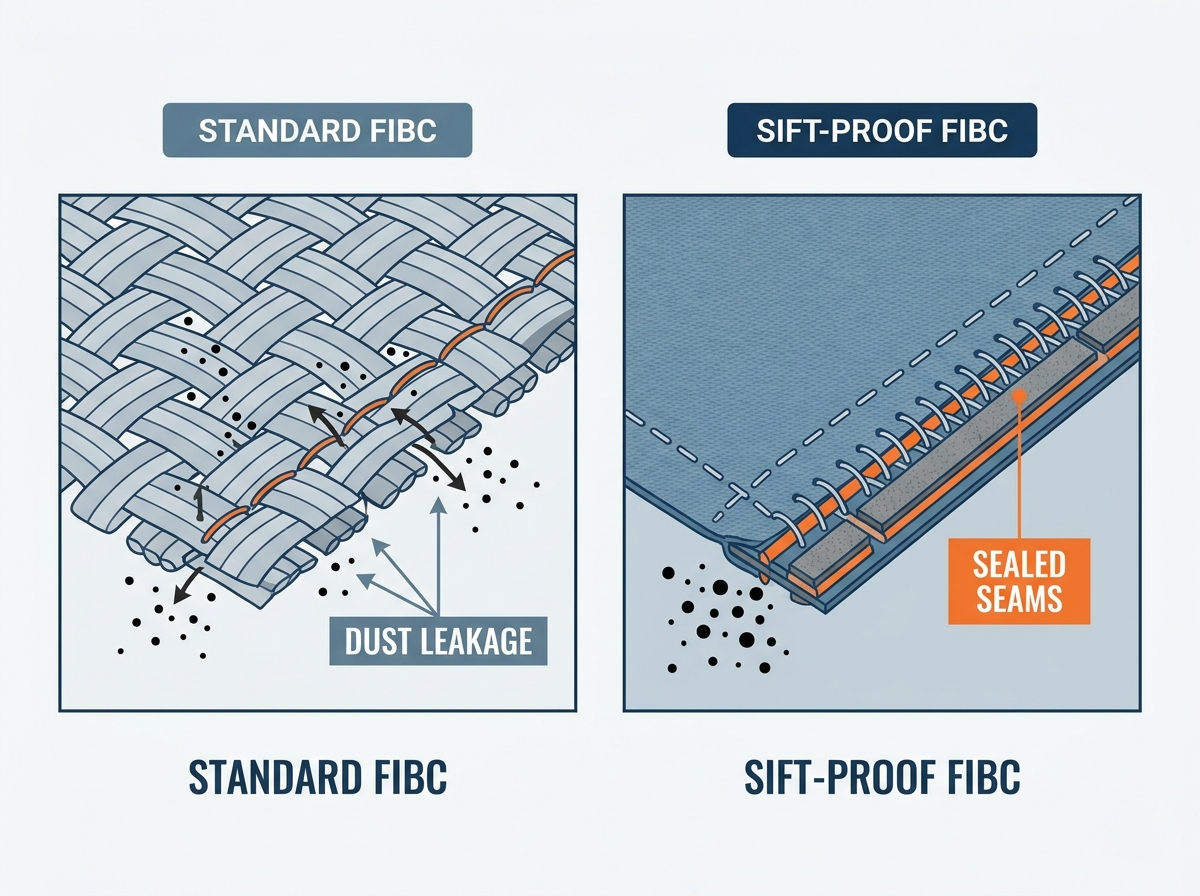
Standard breathable woven polypropylene fails instantly against ultrafine powders. The microscopic gaps between the woven tapes allow fine powder to escape freely. You must mandate fully coated or laminated fabrics for this application. Polypropylene lamination forms a mandatory baseline barrier. It seals the physical gaps across the entire bag surface. Specifying a true sift proof fibc always begins by demanding non-breathable, heavily coated outer fabrics.
Standard sewing destroys the integrity of coated fabrics. Heavy sewing needles punch large holes straight through the material. These holes act as high-speed exit routes for pressurized powder during transit. You must evaluate specialized sift-proof stitching options carefully to seal these puncture points.
Single filler cords: Manufacturers sew a thick yarn directly into the seam to block basic needle holes effectively.
Double dust bands: Soft felt or sponge strips clamp the seam from both sides, providing a thick secondary barrier.
Overlock stitching: This robust sewing method reinforces the seam structure to prevent stretching under extreme weight.
Double dust bands are generally the industry standard for handling ultrafine powders like carbon black. They compress tightly when the bag fills. This compression stops microscopic particles from navigating through the complex seam structure.
Inner liners add the ultimate layer of protection. LDPE, LLDPE, or aluminum foil liners block moisture completely. They also stop the finest dust particles. You must compare internal attachment methods closely. Loosely inserted liners often shift during transit. Tabbed liners stay secure because manufacturers sew them into the main seams. Glued liners bond directly to the outer fabric for maximum stability.
Liner inversion happens frequently during rapid powder discharge. The heavy powder pulls the loose liner down into the discharge spout. This chokes the equipment and halts production instantly. Glued or securely tabbed form-fit liners eliminate this specific operational risk entirely. They maintain their shape as the bag empties.
Standard flat-bottom bags create chaotic dust clouds when cut open. You need elongated discharge spouts to control the material flow. Pair these longer spouts with protective petal closures or star-cut bottoms. These structural additions fold securely over the primary spout. They protect the delicate inner spout from severe abrasion during long transit routes. When operators untie the bag, the elongated spout allows for highly controlled release directly into the receiving hopper.
The physical interface between the bag and your facility docking station matters deeply. Open-air dropping causes massive dust plumes. You must integrate dust-tight equipment seamlessly.
Iris valves: These mechanical devices choke the spout neck gently. Operators can untie the inner string safely without powder rushing out prematurely.
Pneumatic clamps: These automated rings seal the bag spout firmly against the receiving hopper. They create a temporary airtight seal before the flow begins.
Localized dust extraction rings: Specialized HEPA vacuums sit right at the untie point. They capture stray particles instantly before they reach the general factory air.
Rapid product drop displaces air rapidly inside the receiving hopper. The falling powder forces this air upward at high speeds. This displaced air carries thick carbon dust straight out of the bag opening. Industry veterans call this "puffing." Minimize this displaced air carefully through operational best practices. Vent the receiving hopper properly to give the air an escape route. Utilize slower discharge rates to prevent severe puffing events. A controlled flow rate keeps the powder compacted and minimizes disruptive aeration.
Carbon black conducts electricity extremely well. The material poses unique static hazards in any industrial setting. Normal frictional static generates continuously during fast filling and emptying operations. The powder itself compounds this danger by holding electrical charges. Utilizing a proper carbon black bulk bag minimizes this severe danger. Understanding bag classifications protects your facility from catastrophic explosion risks.
Type C bags rely on a specific structural design. Manufacturers weave interconnected conductive threads throughout the main fabric structure. Operators face a mandatory requirement for physical grounding before starting any material flow. You must clip a grounding wire directly to the bag. Address the severe human-error risk here honestly. Un-grounded Type C bags become highly dangerous immediately. An isolated electrical charge causes severe sparks. If an operator forgets the grounding clip, a deadly explosion becomes highly probable.
Type D bags utilize specialized ungrounded dissipative fabrics. Materials like CROHMIQ® dissipate static safely into the surrounding atmosphere via corona discharge. You must compare the upfront cost premium of Type D bags against their immense safety value. Type D bags cost more per unit initially. However, they provide a massive operational safety advantage. They remove the human grounding requirement completely. You eliminate the fatal risk of operator memory failure.
Feature / Specification | Type C (Conductive) | Type D (Static Dissipative) |
|---|---|---|
Mechanism | Conducts charge to earth ground via threads | Dissipates charge into the air via corona discharge |
Grounding Required? | Yes, absolutely mandatory | No, fully ungrounded operation |
Human Error Risk | High (Operator must attach the clip) | Low (Automatic dissipation) |
Cost Profile | Lower unit cost | Higher unit cost |
Ideal Environment | Strictly controlled facilities with interlocks | Fast-paced facilities mitigating operator error |
Carbon black operations require precise packaging matches. You cannot rely on basic catalog bags from generic suppliers. Standard designs fail spectacularly in these harsh environments. Work closely with specialized suppliers instead. They engineer custom bags to match your exact filling and discharging equipment specs. A custom fit ensures the spout diameters match your facility clamps perfectly. Custom engineering eliminates the awkward gaps where fine dust typically escapes.
Demand strict testing transparency before approving any bag specification. Leading suppliers must perform aggressive sift-testing using fine powders. They should run heavy vibration simulations frequently to mimic rough ocean or rail transit. Fabric permeability testing proves the barrier coating actually works under pressure. Review these laboratory results carefully. Approve a new bag specification only after seeing hard data proving full particle containment.
Assess supplier facility standards carefully during your evaluation phase. Ask about their cutting technology. Ultrasonic cutting prevents frayed fabric edges, which keeps stray plastic threads out of your product. Evaluate their general facility cleanliness. Cleanroom conditions prevent pre-shipment contamination. You do not want dust or moisture trapped inside your newly delivered bags.
Evaluate fabric resin quality consistency. Global supply chains fluctuate wildly. Your chosen supplier must guarantee consistent raw materials. Consistent seam construction across multiple global production runs remains critical. A perfectly engineered bag design fails if the factory sews it poorly during the third production run. Demand robust quality assurance documentation for every single shipment.
Upgrading your packaging strategy represents a smart capital decision. Specifying specialized bags directly offsets massive hidden operational costs. You drastically reduce spillage, lower cleaning labor, and mitigate severe safety risks. We thoroughly summarized the necessary evaluation framework above. Focus heavily on coated fabrics, double dust bands, and proper static control mechanisms.
We reiterate one absolute truth: standard bags will always fail against ultrafine powders. The microscopic gaps and unsealed needle holes guarantee costly leaks. Stop accepting this product loss as a normal cost of doing business.
Take immediate action. We highly recommend conducting a thorough packaging audit today. Work alongside a qualified FIBC engineer to review your current processes. Design a custom sift-proof prototype tailored to your specific docking equipment. Conduct thorough site testing to prove the financial value of total dust containment.
A: A sift-proof bag combines fully coated fabrics and specialized filler cords or dust bands. Manufacturers weave these thick elements directly into the main seams. This specific construction blocks the microscopic gaps created by heavy sewing needles. It effectively traps ultrafine powders securely inside during transit.
A: Heavily coated, sift-proof stitched bags can sometimes suffice for very short trips. However, a form-fit internal liner is universally recommended. Liners provide maximum dust control and excellent moisture prevention. They offer an absolute physical barrier against ultrafine particle migration.
A: You should never reuse these bags. Reusing them introduces severe safety and structural degradation risks. Single-trip bags featuring a 5:1 safety factor are the strict industry standard. This ensures complete material integrity and successfully prevents any cross-contamination between batches.
A: Type C bags are highly cost-effective but demand strict physical grounding protocols from operators. Type D bags carry a higher unit cost. However, Type D fabrics safely dissipate static into the air without any physical grounding. They eliminate the catastrophic risk of operator grounding failure entirely.