
Views: 0 Author: Site Editor Publish Time: 2026-11-02 Origin: Site


A mismatched FIBC and hopper interface often causes fugitive dust. It creates significant product waste. It also introduces serious operator safety hazards during daily powder handling operations. When material escapes, housekeeping workloads spike. Operators face respiratory risks and dangerous ergonomic strains. Sizing the connection requires more than simply measuring a diameter. You must carefully align bag specifications and material flow characteristics. You also need to accommodate operator access requirements. Doing this properly stops leaks before they start.
This guide breaks down the critical engineering criteria for matching spout dimensions to hopper inlets. We evaluate various sealing mechanisms and highlight specific equipment requirements. By understanding these tolerances, you can ensure a completely closed-loop, safe discharge process from start to finish.
Matching the FIBC discharge spout size to the hopper inlet is critical for preventing material bridging, ratholing, and dust leaks.
The optimal bulk bag spout connection depends on material flowability, containment requirements (e.g., hazardous vs. inert), and operator access needs.
Integrating dynamic tensioning and proper untie mechanisms within the bulk bag discharger prevents spout collapse during the unloading cycle.
Proper equipment selection must account for dimensional tolerances, including spout length, diameter, and the elongation of the bag as it empties.
A successful connection achieves three primary goals. First, it ensures zero dust escapes into the facility. Second, it allows for complete material evacuation. Finally, it provides ergonomic and safe access for the operator. You need all three conditions to maintain reliable operations. When you misalign the dimensions between the bag and the unloading machinery, you compromise the entire process.
Yield loss and housekeeping burdens immediately signal a problem. A spout designed too large for the receiving hopper causes the fabric to fold inward. These folds create internal ledges. Material becomes entrapped within these crevices. Operators lose valuable product in every batch. Conversely, a spout designed too small restricts the flow rate. The narrow opening creates bottlenecks. Material bridges over the opening, stalling production entirely.
Compliance and safety risks compound these physical flow issues. Fugitive dust creates severe regulatory liabilities. Occupational Safety and Health Administration (OSHA) standards dictate strict limits on airborne particulates. Furthermore, the National Fire Protection Association (NFPA) heavily regulates combustible dust. When a connection fails to seal properly, combustible particles settle on surrounding equipment. You risk a catastrophic secondary explosion if an ignition source reaches this dust. Containing emissions directly at the interface prevents these hazards.
Equipment downtime represents another significant consequence. Operators often resort to manual intervention when flow stops. They hit the hopper walls with mallets. They reach dangerously into live material to clear blockages. These actions halt production. They also introduce severe safety liabilities. Ergonomic injuries occur frequently when workers fight against a poorly fitted interface.
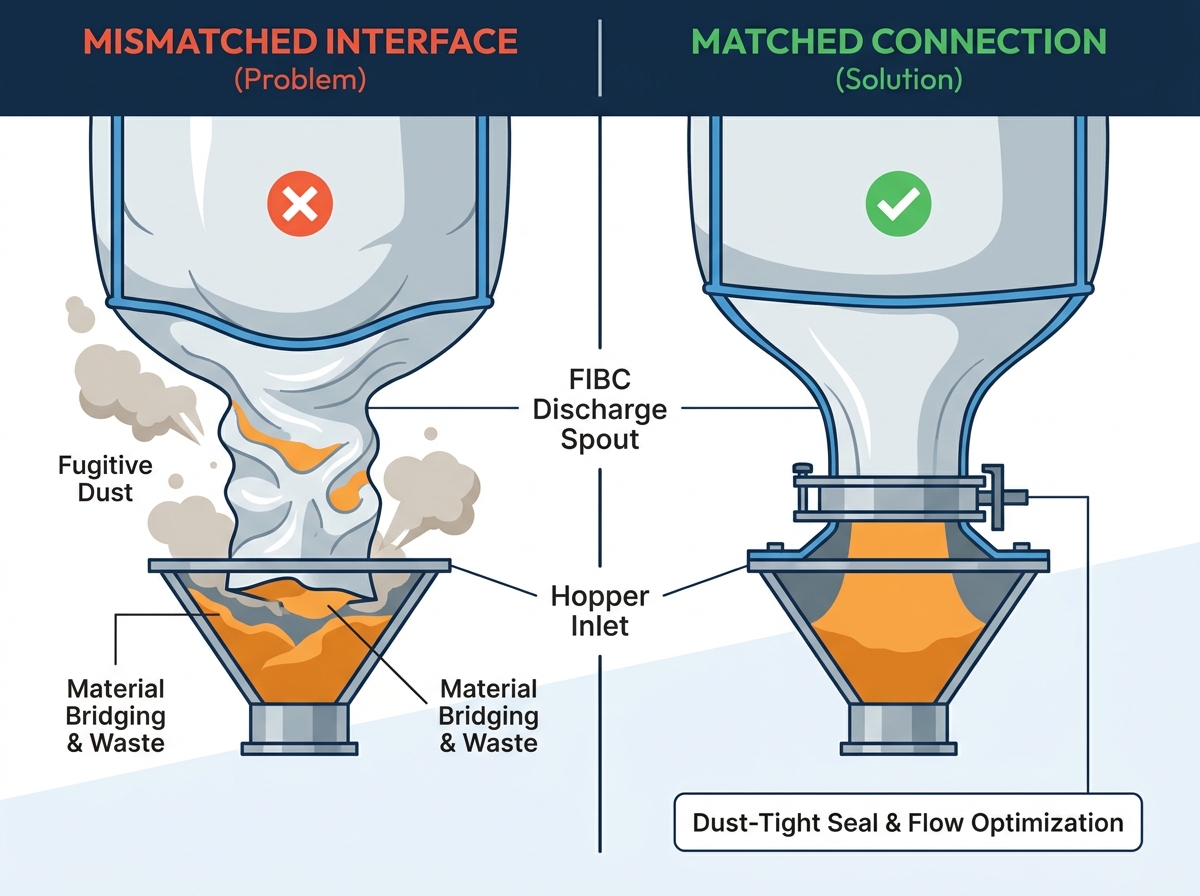
You cannot estimate dimensions when designing a powder handling system. Establishing a core evaluation framework requires measuring and specifying exact tolerances. Engineers must map the bag dimensions against the physical constraints of the receiving equipment.
Evaluating diameter ratios provides the first step. Standard spout diameters typically range from 10 to 18 inches. A common engineering rule of thumb dictates how you match them. The fibc discharge spout size should generally be slightly smaller than the outer clamping ring. However, it must remain large enough to accommodate your required volumetric flow rate. If the diameter shrinks too much, you throttle the process unnecessarily.
Spout length matters just as much as diameter. The fabric must travel through the mechanical interfaces. It must pull cleanly through an iris valve. It must also stretch over a clamping collar without excessive tension. If the length runs short, the operator cannot secure the tie-off strings properly. Conversely, you cannot make it excessively long. An overly long spout bunches up inside the hopper. This bunching restricts flow and creates traps for lingering material.
Material characteristics heavily influence your dimensional choices. You must evaluate the flowability of your powder. Cohesive or sluggish materials behave poorly in confined spaces. They require wider spouts. They also demand steeper hopper angles to break the friction against the walls. Free-flowing plastic pellets might pass easily through a 10-inch opening. Cohesive titanium dioxide might bridge instantly in that same space, demanding a 15-inch or larger opening.
Table: Spout Configuration Guidelines Based on Material Flow
Material Flow Profile | Typical Spout Diameter | Hopper Angle Requirement | Primary Challenge |
|---|---|---|---|
Free-Flowing (e.g., Plastic Pellets) | 10" – 12" | Standard (45° - 60°) | Preventing runaway flow surges |
Semi-Cohesive (e.g., Flour, Sugar) | 12" – 14" | Steep (60° - 70°) | Managing occasional bridging |
Highly Cohesive (e.g., Pigments) | 14" – 18" | Very Steep (70°+) | Ratholing and severe entrapment |
Choosing the right interface technology determines your containment success. You must compare solution categories objectively. Different mechanisms suit different materials and hazard levels. Selecting an inappropriate seal leads to airborne contamination and operator exposure.
Manual untie boxes work best for non-hazardous, free-flowing materials. The operator opens an access door, reaches inside, and unties the strings by hand. These boxes require ergonomic access doors to prevent shoulder strain. They offer a low-cost solution for simple processes. However, they expose the operator directly to the material. You should avoid them when handling toxic or highly dusty powders.
Iris valves, sometimes called choke rings, offer a different approach. They temporarily choke the spout fabric. Operators can untie the bag safely above the choke point before releasing the flow. This provides excellent flow control. You can stop and restart the discharge mid-batch. The main drawback involves wear and tear. The mechanical choking action causes friction against the spout fabric, potentially degrading it over repeated uses.
Pneumatic clamping collars represent the industry standard for a dust-tight seal. The operator pulls the spout over a rigid inner tube. An outer pneumatic ring then expands, sealing the fabric tightly against the tube. This automates the containment process. It provides extremely high containment levels. The primary disadvantage is the larger upfront equipment investment required.
You must view these technologies through a skeptical lens. Avoid vendor claims of absolutely "perfect" seals without proper operational procedures. Even the best pneumatic clamps require careful manual handling. The operator must smooth out wrinkles in the spout fabric before inflating the bladder. Failure to remove folds causes micro-leaks. Dust will escape through these tiny channels under pressure. Finding the best bulk bag spout connection requires matching the technology to diligent operator training.
Table: Comparison of Spout Connection Mechanisms
Mechanism Type | Containment Level | Best Use Case | Primary Limitation |
|---|---|---|---|
Manual Untie Box | Low to Moderate | Inert, granular materials | High operator exposure risk |
Iris Valve / Choke Ring | Moderate | Batch dosing applications | Fabric wear from constriction |
Pneumatic Clamping Collar | High | Fine, dusty, or hazardous powders | Requires pneumatic air supply |
Understanding implementation realities requires looking beyond static measurements. You must examine how the connection behaves dynamically during the discharge cycle. A stationary evaluation rarely tells the full story. The bag shifts, elongates, and empties over several minutes.
Dynamic bag elongation presents a major engineering challenge. As the bag empties, it loses its rigid shape. The bottom sags downward. If left unsupported, the fabric drops directly into the hopper inlet. This creates a massive blockage. To prevent this, a bulk bag discharger relies on spring-loaded or pneumatic tensioning frames. These frames continuously pull the top of the bag upward as the weight decreases. This action keeps the lower spout perfectly taut. It prevents the fabric from sagging into the connection point.
Venting and dust collection require equal attention. When tons of material rush into an empty hopper, they displace a massive volume of air. This air must go somewhere. If unmanaged, it blows backward up through the spout, carrying dust with it. You must manage this displacement air effectively. Integrating a dust collection port at the hopper interface provides a vacuum source. This vacuum pulls away airborne particles immediately when the operator unties the bag. It keeps the workspace clear.
Flow promotion devices often cause unexpected interferences. Many systems use side-massage paddles to break up compacted powder. These paddles aggressively squeeze the bottom of the bag. Buyers must ensure these physical aids do not interfere with the sealing connection. Aggressive massaging can sometimes yank the fabric upward. This yanking motion can pull the bag right out of the clamping ring, dumping material everywhere. Proper frame geometry prevents this conflict.
Procurement and engineering teams need a reliable framework. Shortlisting the right equipment requires systematic logic. Rushing into a purchase without verifying dimensions guarantees integration failure down the line. Follow these structured next steps.
Audit Current FIBC Inventory: Do not spec a hopper based on a single bag. Standardize the diameter and length across all your suppliers. Different vendors often sew bags with slight variations. Establish a strict tolerance range before designing the metal interfaces.
Define Containment Levels (OELs): Determine your required Occupational Exposure Band. Match the connection mechanism to the hazard. A standard manual clamp works for sugar. Active pharmaceutical ingredients demand glovebox isolation or high-grade pneumatic seals. Safety data dictates the mechanical choice.
Execute Factory Acceptance Testing (FAT): Never finalize a purchase based purely on drawings. Advise your vendor to conduct a physical test. Send your actual production bags and actual material to the manufacturer. Test the equipment under real-world tension. Observe how the fabric interacts with the clamps during a live discharge.
Executing this checklist eliminates assumptions. It forces suppliers to prove their equipment handles your specific packaging dimensions effectively.
Matching a discharge spout to an unloading hopper demands precision engineering. It directly dictates your operational safety and daily efficiency. It prevents costly material waste and eliminates dangerous respiratory hazards. You cannot treat this connection point as a simple afterthought during system design.
To move forward successfully, implement these action-oriented next steps:
Audit your existing bag inventory to establish a rigid dimensional baseline.
Assess your material flow properties to confirm your required diameter.
Consult with bulk handling system engineers to conduct live flowability tests.
Specify tensioning frames to manage dynamic bag elongation automatically.
By prioritizing the interface geometry, you protect your operators and streamline your entire production line.
A: Standard diameters typically range from 10 to 18 inches. Lengths generally span from 18 to 24 inches. However, customization remains highly common. Facilities base exact dimensions on specific material flow properties and discharge equipment requirements.
A: You prevent leaks by utilizing pneumatic clamping rings that create a tight seal. Furthermore, you must maintain upward bag tension throughout the entire discharge cycle. Connecting the untie box to an active dust collection system captures any displaced air.
A: Yes, but only within a very specific range. Clamping collars and iris valves possess mechanical limits. If you have significant variations in bag sizes across suppliers, you may require interchangeable hopper transition pieces to accommodate them safely.
A: The excess fabric will bunch or fold inside the hopper. This creates a physical ledge that traps falling material. It severely restricts the flow rate and potentially causes cross-contamination between consecutive batches.