
Views: 0 Author: Site Editor Publish Time: 2026-10-18 Origin: Site


Transporting plastic resins demands a careful balance. You must maximize payload efficiency while maintaining strict safety controls. Facility managers face tough choices daily. Selecting the wrong bulk bag causes severe consequences. You might face moisture contamination ruining expensive batches. Static-induced hazards during discharge can trigger catastrophic explosions. Even minor warehouse inefficiencies stem from bags bulging out of shape. We built this guide to solve these exact problems. It provides a technical, evidence-based evaluation framework. Procurement and logistics teams will learn to match bag features to handling systems. You will understand static control necessities and bulk density calculations. We will guide you through choosing structural designs, liners, and discharge mechanisms. Read on to master selecting the right packaging solutions. Keep your facility safe, efficient, and compliant.
Static control is non-negotiable: Resin friction generates static; choosing between Type B, C, or D bags is dictated by your facility's flammable gas/dust environment.
Bulk density drives design: Most plastic pellets have a bulk density of 30–40 lbs/ft³, dictating the Safe Working Load (SWL) and dimensional requirements of the bag.
Baffle bags maximize ROI: Form-stable designs prevent bulging, allowing for optimal use of shipping container space and safer stacking.
Contamination prevention requires specifics: Sift-proof seams and specialized liners are required for hygroscopic resins or micro-pellets.
Handling plastic resins involves distinct physical challenges. The very nature of plastic granule packaging requires understanding material behavior. You cannot treat resin like standard agricultural products. These materials exhibit unique traits during transport.
Pellets generate massive static electricity. They move rapidly during filling and discharge. They rub against each other constantly. This friction creates high static charges. Unchecked static buildup presents a massive fire risk. Specialized fabric treatments become absolutely necessary. You must control these charges to protect workers. Ignoring this risks facility safety and compliance violations.
Many engineering resins absorb ambient moisture easily. Materials like PET or Nylon degrade quickly upon exposure. They absorb water vapor right out of the air. This happens long before the molding process begins. Moisture causes severe production flaws later. You face weak structural integrity in the final molded parts. Strong vapor barriers stop this hygroscopic degradation completely.
Uniform, smooth pellets behave exactly like a fluid. They shift easily during transit. They exert intense outward pressure against flexible walls. This pressure pushes against the fabric continuously. Standard bags will distort, lean, or fall over entirely. Structural reinforcement is vital for warehouse stability. You must contain this outward force effectively.
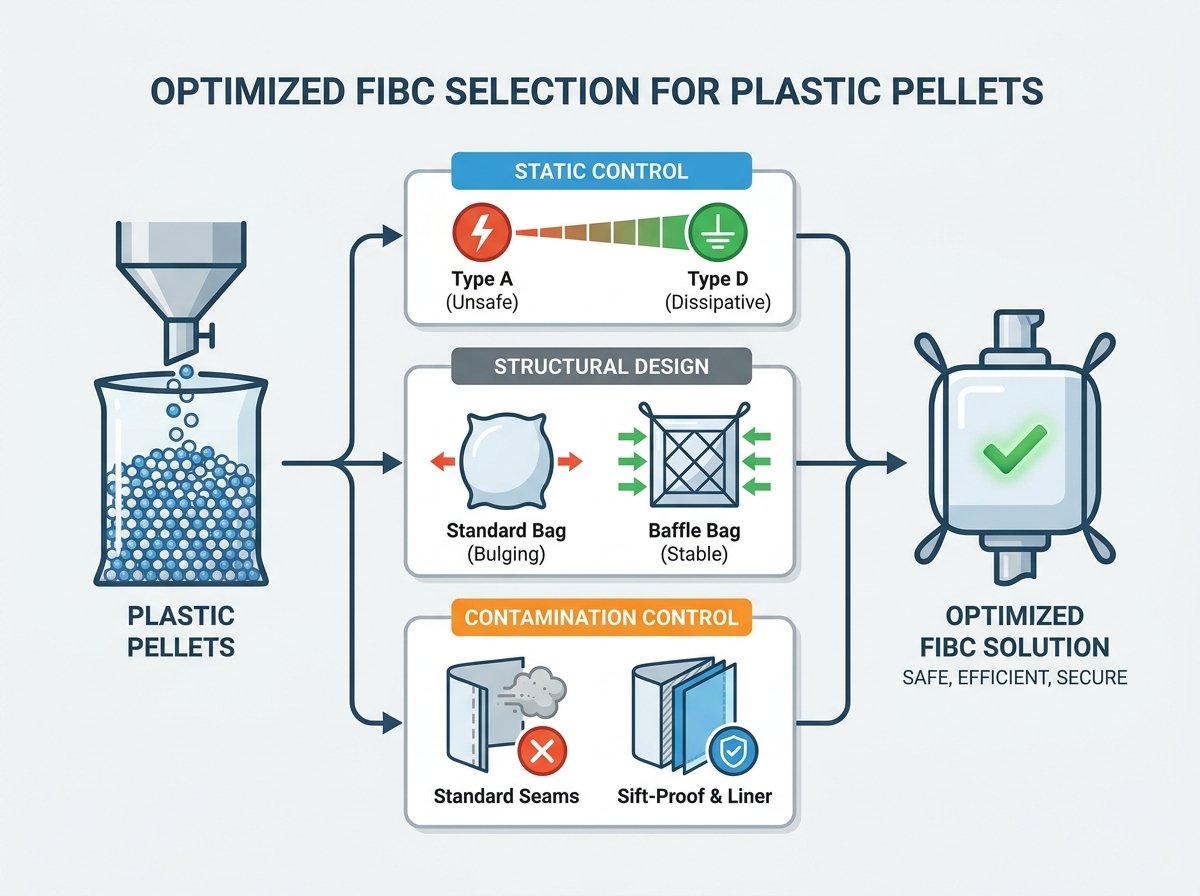
Static buildup poses a severe risk in resin handling. You must choose the right bag classification. This prevents dangerous propagating brush discharges. The wrong choice introduces ignition sources into your facility. We categorize these containers into four distinct safety types.
Manufacturers weave these from standard polypropylene. They offer zero static protection. You should never use them for combustible materials. Keep them away from flammable environments entirely. They suit non-hazardous, non-combustible products only. Resin handlers rarely use them due to inherent dust risks.
These bags prevent propagating brush discharges. They feature a low breakdown voltage fabric. They work well for dry, combustible resin dust. You can use them safely in specific zones. However, ensure no flammable solvents or gases exist nearby. They do not dissipate static into the air actively.
Manufacturers interweave conductive threads throughout the fabric paneling. A strict operational mandate applies here. You must physically ground them during filling and emptying. A failed ground connection risks a devastating spark. This requires rigorous training for your warehouse staff. Human error remains the biggest vulnerability here.
These safely release static charge directly into the atmosphere. You do not need a physical ground connection. This makes them the safest option for automated lines handling resin pellet bulk bags. They utilize special anti-static yarns. Human error cannot compromise their safety mechanisms. We strongly recommend them for high-volume, automated environments.
Bag Type | Grounding Required? | Safe for Combustible Dust? | Safe for Flammable Gas? |
|---|---|---|---|
Type A | No | No | No |
Type B | No | Yes | No |
Type C | Yes (Strictly) | Yes | Yes |
Type D | No | Yes | Yes |
Your logistics network relies on precise packaging dimensions. We calculate these using your material properties. Haphazard sizing leads to wasted shipping space. It also causes dangerous container instability.
Bulk density dictates your required dimensions entirely. Most plastic pellets sit around 30 to 40 lbs/ft³. You must calculate the footprint to hit payload targets. A standard 1,000 kg (2,200 lb) payload needs a specific cubic volume. We size the fabric container to hold exactly this volume. Lighter resins require taller configurations to hit the SWL. Dense resins require shorter, wider builds.
We strongly contrast standard U-Panel bags against baffle designs. Standard tubular bags turn completely cylindrical when filled. Baffle bags feature internal corner fabric panels. These panels keep the exterior completely square. You gain up to 30% more efficiency in sea freight containers. They sit flush against each other. They stack safely in high warehouse racking systems. You eliminate leaning pallets instantly.
ISO industry standards dictate strict structural integrity limits. Testing facilities evaluate these through rigorous drop tests. A 5:1 SF rating suits Single Trip uses perfectly. The fabric handles five times its rated load before failing. A 6:1 SF rating applies strictly to Multi-Trip uses. You evaluate these ratings based on your supply chain loop. Closed-loop systems benefit greatly from 6:1 ratings.
Keeping resin pure dictates the quality of your final product. fibc bags for plastic pellets must prevent outside contamination completely. They must also retain microscopic particles securely.
Inner liners add essential defensive barriers. Standard woven polypropylene allows air to pass through. Liners stop this transmission. Evaluate the following materials:
Polyethylene (PE): Works excellently for standard moisture and dirt protection. It fits most commodity resin needs.
Polypropylene (PP): Offers distinct chemical resistances. Handles higher temperature fillings easily.
Aluminum Foil: Blocks oxygen and moisture vapor completely. You need foil for highly sensitive engineering resins.
How you attach the liner matters immensely. Loosely inserted liners cause massive operational headaches. They often bunch up or slip out during discharge. Glued liners can break loose under heavy material pressure. Tabbed liners remain the absolute best choice. Manufacturers sew eight specific tabs right into the outer seams. This secures the liner permanently. It prevents the plastic film from discharging alongside your pellets.
Standard stitching creates tiny puncture holes. Fine powders escape through these gaps easily. We highly recommend double dust seams. Manufacturers sew soft filler cords along the stitch lines. This blocks tiny gaps perfectly. Facilities often handle mixed batches of large pellets and micro-granules. Sift-proof seams prevent costly material loss. They keep your factory floor clean and safe.
Equipment compatibility dictates your spout features. You must match container openings to your machinery. Manual processes need different designs than robotic lines. Getting this wrong slows down your entire factory.
Compare the two primary top designs used in resin handling:
Spout Top: Best for dust control and automated filling. It secures tightly around fill pipes. It prevents airborne dust during high-speed loading.
Duffle Top: Better for manual or oversized loading. A large opening fits irregular filling chutes. Workers tie it shut manually after loading.
The Spout Bottom acts as the undisputed industry standard. It enables controlled, metered release of plastic pellets. Extruders and mixing hoppers require this precision. Flat bottom bags require destructive cutting to empty. You avoid cutting entirely by using spout bottoms. Workers untie the spout safely from a distance.
You need secondary security to stop accidental leaks. Primary ties sometimes fail during rough transit. Evaluate these popular closure methods:
Petal Closures: Flaps fold over the spout for physical protection. They guard against abrasion.
Star Closures: Fabric panels fold into a star pattern. They secure the bottom heavily.
Iris Valves: These provide external mechanical flow control. You use them to choke the spout mid-flow. They allow precise partial discharges.
Feature Category | Standard Option | Premium Option for Resins |
|---|---|---|
Seams | Standard Overlock | Double Dust Seam (Sift-Proof) |
Shape Retention | U-Panel / Tubular | Internal Baffles |
Discharge Mechanism | Flat Bottom | Spout Bottom with Iris Valve |
Liner Attachment | Loosely Inserted | Sewn-in Tabs |
Environmental goals reshape modern packaging strategies. Companies demand greener supply chain practices everywhere. You can align packaging choices with corporate sustainability targets.
Procurement departments face new judgments today. Sustainability metrics carry heavy weight in corporate reporting. Packaging waste reduction stands as a top priority. Single-use plastics face intense regulatory scrutiny globally. Transitioning to smarter bulk packaging improves your environmental footprint. It demonstrates concrete ESG commitments to your stakeholders.
You can implement a highly viable closed-loop system. Polypropylene offers excellent recyclability. The process follows a strict chain of custody. Facilities collect used bags after emptying the resin. Certified recyclers clean the fabric thoroughly. They shred and regranulate the woven polypropylene. Manufacturers then reintegrate this resin into new packaging lifecycles. This diverts massive tonnage from local landfills.
Recycling networks do not exist everywhere yet. You can propose 6:1 SF bags for captive supply chains instead. Moving resin between two company-owned facilities fits this perfectly. You collect the empty bags and send them back. You drastically cut total packaging volume. You slash purchasing budgets over the year. Fewer bags enter the waste stream overall.
Finalize your packaging strategy methodically. Haphazard choices lead to damaged resin and unsafe floors. Follow these action-oriented steps to secure the perfect packaging solution.
Identify static risk first: Determine your facility dust and gas environment to choose between Type B, C, or D fabrics.
Calculate size mathematically: Use your specific resin bulk density to finalize exact container dimensions.
Select structural form: Mandate internal baffles to maximize container space and prevent leaning.
Determine hardware compatibility: Match spouts and liners directly to your filling and extrusion machinery.
Advise your procurement teams to act now. Audit your current filling and discharge equipment today. Consult with a certified bulk packaging manufacturer. Request a sample unit tailored to your specific resin. Run a small pilot test on your floor. Confirm operational performance before placing large bulk orders.
A: A payload of 1,000 kg (2,200 lbs) serves as the industry standard SWL. However, the physical dimensional volume required varies completely. It depends entirely on the specific resin bulk density. Lighter pellets require taller bags to reach that target weight safely.
A: Yes, if you specify 6:1 multi-trip ratings. Standard 5:1 bags are strictly for single-trip use. Note that cross-contamination risks often restrict reuse. It usually works best in closed-loop pipelines handling a single material between owned facilities.
A: No. Aluminum foil liners are only strictly necessary for highly hygroscopic engineering resins. These sensitive plastics require absolute total vapor barriers. For most standard commodity plastics, standard polyethylene (PE) liners provide entirely sufficient moisture protection.
A: This happens because you likely use standard tubular or U-panel designs. They lack internal support panels. Combined with the fluid dynamics of smooth plastic pellets, outward pressure forces them into a cylinder. Upgrading to baffle designs solves this by holding a strict square shape.