
Views: 0 Author: Site Editor Publish Time: 2026-10-13 Origin: Site


Warehouse managers face a constant operational tension every single day. You must maximize your vertical floor space for ultimate cost-efficiency. However, you cannot compromise facility safety or risk product loss. Can flexible intermediate bulk containers go vertical? Yes, FIBCs can be stacked safely. Doing so requires strict adherence to specific bag constructions, uniform material filling, and standardized handling protocols. Overlooking any single requirement invites disaster on the warehouse floor. This guide outlines the structural prerequisites, approved stacking methodologies, and critical risk factors necessary for safe, high-density bulk bag storage. You will learn how to audit your base layers and match safety factors correctly. Ultimately, you will gain actionable strategies to protect your team and inventory while optimizing your overall warehouse footprint.
Design matters: Stackability relies primarily on internal bag construction (specifically baffled designs) and precise fill uniformity.
Methodology is strict: Free-standing stacks must utilize a pyramid formation or supported-wall layout to distribute weight safely.
Inspections are non-negotiable: Pre-stacking checks for UV damage, webbing integrity, and moisture ingress are mandatory for compliance.
Procurement logic: Purchasing decisions for multi-tier storage must account for strict Safety Factors (e.g., 6:1 vs. 5:1) and exact pallet-to-bag dimensional matching.
Safe fibc bag stacking requires rigid shapes and predictable footprints. Baffled bags (Q-Bags) are the undisputed industry standard for vertical storage. Standard bags tend to bulge outward under immense interior pressure. Baffles prevent the bag from "bellying" outward along the sides. They maintain a square footprint essential for stacking stability. The inner panels pull the corners tight during the filling process. This creates a flat, wide surface for upper tiers to rest upon securely. You cannot build a stable tower on a round, bulging foundation.
Filling bags correctly is non-negotiable for safety. You must use vibration or settling tables during the filling process. Unsettled materials shift unexpectedly under vertical pressure. This shifting instantly alters the center of gravity. Stack failure often follows rapidly when the core moves. Aerated powders are especially prone to this settling effect over time. Vibration forces trapped air out before you seal the bag. It densifies the material into a solid, immovable block.
Pallet dimensions matter immensely in your warehouse. Filled bags must sit perfectly square within the pallet dimensions. Edge overhang concentrates downward force unevenly across the base. This leads to rapid bottom-tier failure. Operators must center the bag before opening the discharge chute. Every corner must rest securely on the wood or plastic base. If you ignore pallet alignment, you risk tearing the lower fabric seams under heavy compression.
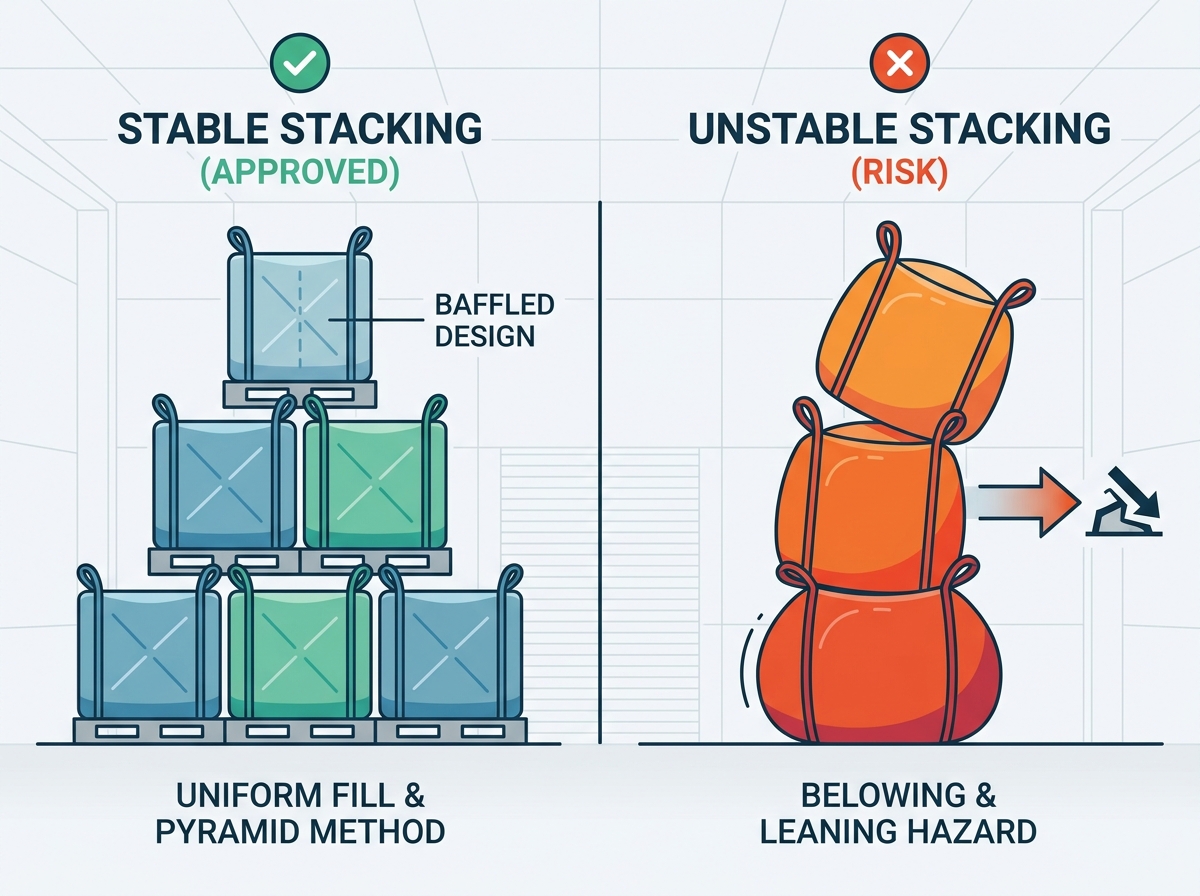
Optimizing bulk bag warehouse storage demands standardized physical arrangements. Do not improvise layouts on the fly.
Outline the mechanics of free-standing pyramid stacking carefully. Each subsequent tier is stepped inward systematically. It rests on at least two bags below it to safely distribute the load. The top bag essentially binds the lower structure together. You must avoid stacking bags in isolated, single-file columns. Straight vertical columns carry severe tipping risks because they lack lateral support. A small nudge from a forklift can topple an isolated column instantly.
Detail engineered retaining walls for supported stacking setups. Supported stacking prevents lateral shifting effectively. The outer bags rest against strong physical barriers for extra stability. However, verify the structural load rating of the warehouse walls before utilizing this method. Bulk materials exert immense lateral pressure against adjacent structures. Weak walls will buckle under prolonged storage pressure. Consult structural engineers before leaning tons of product against sheet metal siding.
Direct stacking has strict operational limits. Highly fluid powders or hazardous chemicals cross that risk threshold quickly. You should transition to heavy-duty pallet racking here. Drive-in or flow racks remove direct compressive weight from the bags entirely. The steel beams support every ounce of your inventory. This eliminates bottom-tier failure risks completely.
Follow these steps when transitioning to racking systems:
Assess your bulk material fluidity and chemical hazard levels thoroughly.
Evaluate your standard pallet rack load capacities against your heaviest filled bag.
Install sturdy wire decking to prevent wooden pallet sag over time.
Ensure adequate forklift mast clearance between the vertical beam levels.
Ensuring jumbo bag stacking safety is an ongoing daily commitment. Visual checks save lives and prevent catastrophic material spills.
Outline the visual inspection protocol for leaning stacks. Establish a zero-tolerance policy for deviation from a strict vertical axis. Any visible lean requires immediate dismantling and restacking. Operators should stand back at least twenty feet to assess the plumb line properly. A two-degree lean can trigger a catastrophic collapse overnight. Gravity never forgives poor alignment. Use hanging plumb lines in aisles as quick visual references for your forklift drivers.
Frame the evaluation of the base layer meticulously. Look for early signs of compression fatigue. Stretching or moisture wicking occurs frequently during prolonged storage. Moisture ruins woven polypropylene faster than operators realize. The bottom fabric absorbs ground dampness easily through wooden slats. Pallets help elevate the bag, but condensation still accumulates in humid facilities. Weakened fabric tears easily under multi-tier pressure. Check the bottom seams weekly for stress fractures.
Detail UV exposure and climate risks carefully. Extreme temperature fluctuations degrade woven polypropylene (PP) over time. Humidity also plays a significant role in fabric breakdown. These factors drastically reduce the safe load-bearing capacity of stacked bags. A bag left in direct sunlight loses half its tensile strength rapidly. Sun-damaged bags crack instead of stretch when placed under load. Keep all stacked inventory away from unshaded warehouse skylights and open loading dock doors.
Warehouse errors compound quickly when handling bulk materials. Small handling mistakes scale into massive safety hazards.
Explain the physics of multi-tier storage clearly to your team. The bottom bag must handle incredible vertical stress. It holds its own internal contents safely. It also carries the aggregate downward pressure of all tiers stacked directly above it. If you stack three bags weighing 1,000 kg each, the bottom layer bears an extra 2,000 kg. Do not exceed the cumulative rated capacity. Always calculate the total stack weight before placing the first bag.
Discharge spouts cause problems frequently in busy facilities. Poorly secured bottom spouts create an uneven base layer. This introduces an immediate tipping hazard for the entire stack. A lumpy bottom prevents the bag from sitting flat on the pallet. Warehouse staff must fold and tie off the spout tight. The star-closure must lay flush against the bag bottom seamlessly. Train operators to tuck the spout smoothly to guarantee a flat footprint.
Minor punctures matter immensely. Dragged loops or tine abrasions happen during transport. These hidden damages compromise the fabric's tensile strength severely. They make the bag a massive liability in a tall stack. Forklift tines act like dull knives on tensioned woven fabric. You must discard any scraped or snagged bags immediately. Never place them at the base of a stack under any circumstances.
Ground the operations in recognized industry standards. The Flexible Intermediate Bulk Container Association (FIBCA) provides clear handling guidelines. OSHA and HSE enforce warehousing compliance regarding unstable overhead loads. Inspectors heavily penalize leaning inventory during routine facility audits. Ignoring guidelines exposes your facility to heavy regulatory fines. More importantly, it endangers your floor workers daily. Document your safety checks to prove compliance.
Purchasing decisions dictate your ultimate storage success. You must buy bags engineered for specific warehouse realities.
Provide shortlisting logic for selecting bags carefully. You must choose between standard single-trip (5:1 SF) and heavy-duty multi-trip (6:1 SF) bags. Base this vital choice on anticipated stacking height and total storage duration. A 6:1 safety factor provides essential buffer margins for heavy loads. Use higher ratings for long-term multi-tier projects exclusively. Standard 5:1 bags are excellent for transport but lack the endurance for multi-year vertical stress.
Specification | 5:1 Safety Factor | 6:1 Safety Factor |
|---|---|---|
Primary Use Case | Single-trip applications | Multi-trip or high-density storage |
Stacking Recommendation | Limited to lower tiers or racking | Approved for multi-tier free-standing stacks |
Fabric Durability | Standard woven PP | Reinforced heavyweight PP |
Cost Implication | More economical initially | Higher upfront cost, longer lifespan |
Advise on specifying custom bag dimensions accurately. They must match the exact footprint of standard facility pallets perfectly. This strategy naturally engineers a highly stable stack base. A 40x48 pallet requires a perfectly fitted bulk bag. Gaps on the pallet invite severe load instability. Overhang guarantees bottom-tier rupture eventually. Work closely with your packaging supplier to dial in these specs. Provide them with your exact pallet dimensions before ordering a new batch.
Frame the next steps for diligent buyers. Require your vendors to provide independent testing certifications upfront. Third-party load-testing proves the bag can survive extreme vertical pressure safely. Demand tangible proof of strict quality control before approving them. Never use untested or unverified bags for high-risk stacking applications. Certificates of conformity should accompany every shipment you receive. Review these documents quarterly to ensure ongoing vendor compliance.
FIBC bag stacking is a highly engineered process. It is not merely a space-saving warehouse hack. Precision matters at every operational level. Safety relies equally on procurement and daily operations. Buying the right bag is just the first step. Handling it correctly keeps your facility running safely. Next-step action: Audit your current bag specifications and handling protocols today. Assess your warehouse environment for leaning stacks and damaged pallets. Consult an FIBC packaging specialist to ensure full compliance. Protect your inventory and your workforce by removing guesswork entirely.
A: It depends heavily on the bag's safe working load (SWL), material contents, and chosen structural method. Standard operations usually cap at two to three tiers for free-standing pyramids. Racked storage allows higher vertical placement because steel beams bear the compressive weight. Always consult manufacturer limits before adding tiers.
A: Yes, generally. Pallet-less stacking creates significant risks. Base instability easily triggers a collapse. Floor dampness can also degrade the bottom bag material quickly. Pallet-less storage is strongly discouraged unless you operate highly specialized handling equipment designed explicitly for lifting unsupported bulk containers safely.
A: The degradation timeline of standard polypropylene dictates storage limits. UV exposure from warehouse skylights rapidly destroys fabric strength. High humidity and temperature swings also weaken the material. Typically, indoor bags last up to one year. Always inspect fabric integrity before attempting to move long-term stacked inventory.